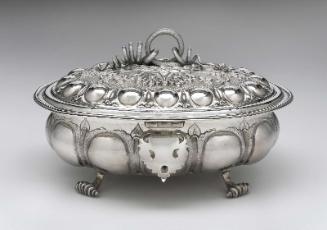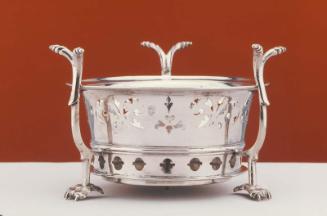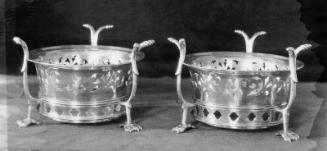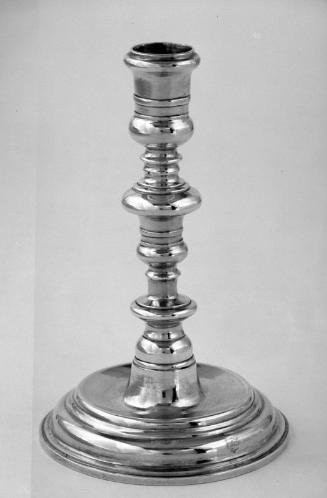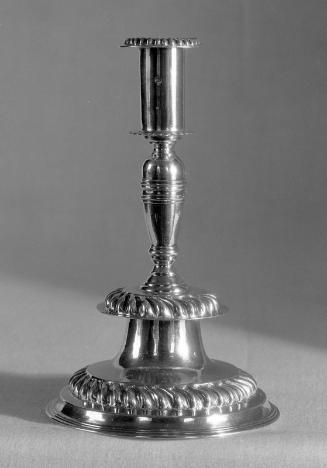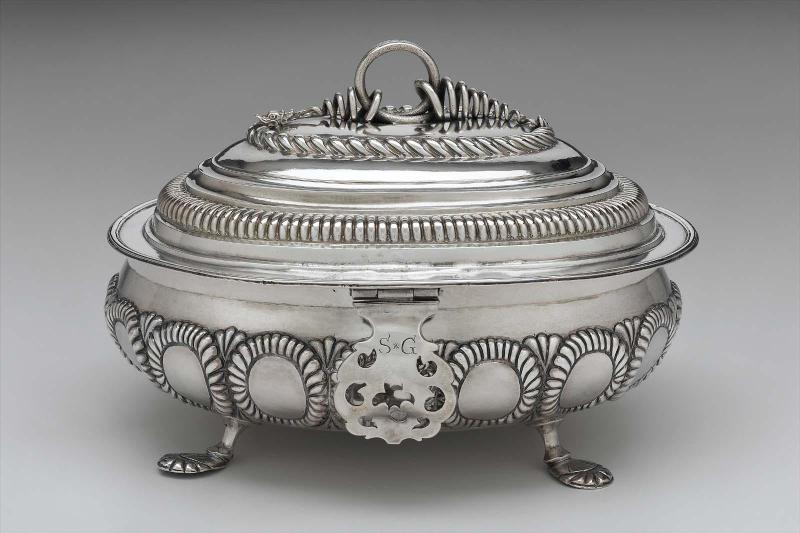
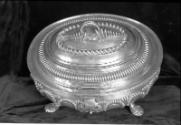
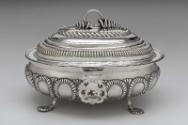
Sugar box
John Coney
(American, 1655 or 1656–1722)
about 1700
Object PlaceBoston, Massachusetts
Medium/TechniqueSilver
DimensionsOverall (h.x w. x d.): 16.7 x 20.3 x 14 cm (6 9/16 x 8 x 5 1/2 in.)
Credit LineBequest of Charles Hitchcock Tyler
Accession number32.370
On View
On viewClassificationsSilver hollowware
Collections
Sweetness and silver were luxuries purchased at a great price-in both human and economic terms-in the seventeenth and eighteenth centuries. Inhumane slave labor was used to extract silver ore from the mines at Potosi and elsewhere in South America and to grow and harvest sugar cane in the West Indies. Wealthy consumers then expended considerable sums to buy the imported sugar and to commission elaborate silver vessels, such as these three sugar boxes, to hold the precious substance on their tables.Of the ten known survivingAmerican sugar boxes, nine, including the three examples shown here, are by John Coney or Edward Winslow of Boston, while one anomalous example is marked by Daniel Greenough of New Hampshire. Fashioned in the form of Italian cassoni (chests) and richly ornamented, these boxes are among the finest examples of early American silver. The elaborate chasing on each box may be the work of a skilled immigrant specialist. Nathaniel Gay may have been responsible for the chasing on the early Coney box (13.421), while Henry Hurst may have performed a similar role for the Winslow example (42.251). In the seventeenth century, sugar was thought to possess special powers: one writer in 1637 argued that it "nourishes the body, generates good blood, cherishes the spirit, makes people prolific, [and] strengthens children in the womb." The iconography of the boxes alludes to marriage, fecundity, and fertility, making them "colonial expressions of courtly love" perfectly suited to house a material thought to contain reproductive and amatory properties. This text was adapted from Ward, et al., MFA Highlights: American Decorative Arts & Sculpture (Boston, 2006) available at www.mfashop.com/mfa-publications.html.
InscriptionsSG on haspProvenanceSamuel Gardner of Salem, Massachusetts (1648-1724); the inventory of his grandson of the same name (1712-1769) listed "1 sugar box wt 23 oz". 1932, bequest of Charles Hitchcock Tyler to MFA. (Accession date: Sept 1, 1932)