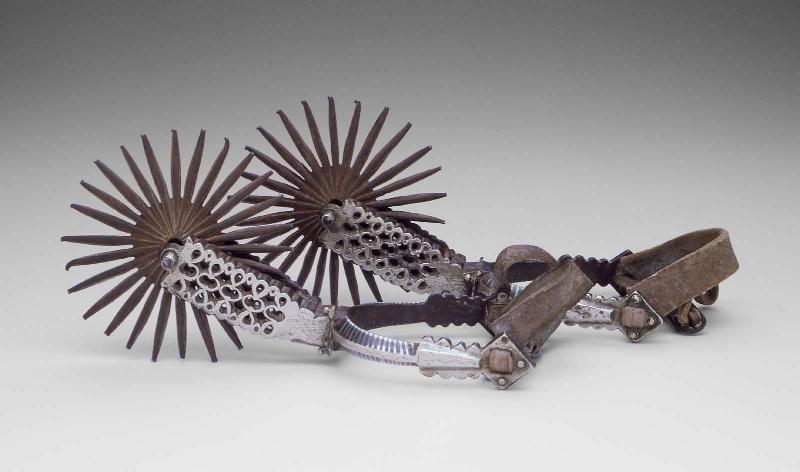
Spur (espuela), one of a pair
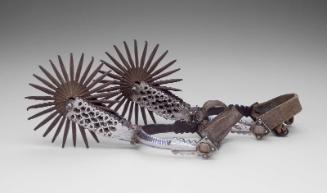
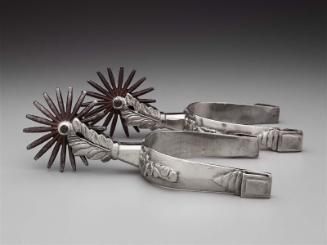
European spurs are generally small affairs in which rowels of modest size are affixed to slender but sturdy frames of wrought iron, steel, and occasionally silver. For the horsemen of Latin America, however, iron was an expensive commodity that was generally shipped from Europe for use primarily as structural supports in mine shafts. This example was undoubtedly costly. The silver decoration has been applied to a wrought-iron framework. The spurs in the next two entries (cat. nos. 412 – 413) are made entirely of silver, a popular alternative to iron or steel.
The niello arch seen here recalls the influence of the Moors, who introduced this metalworking technique to Spain during their seven-century occupation of the Iberian Peninsula. When the rowels are large, as here, they are called nazarenas in South America because the sharp barbs recall the crown of thorns worn by Jesus of Nazareth. The pierced rectangular rowel box is typical of examples made in Chile.
This text has been adapted from "Silver of the Americas, 1600-2000," edited by Jeannine Falino and Gerald W.R. Ward, published in 2008 by the MFA. Complete references can be found in that publication.