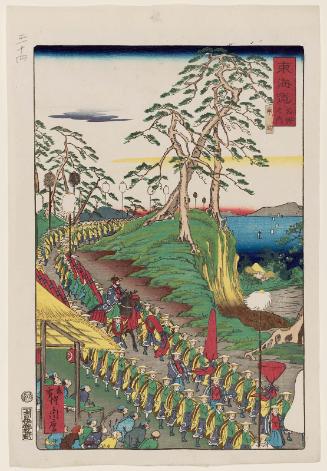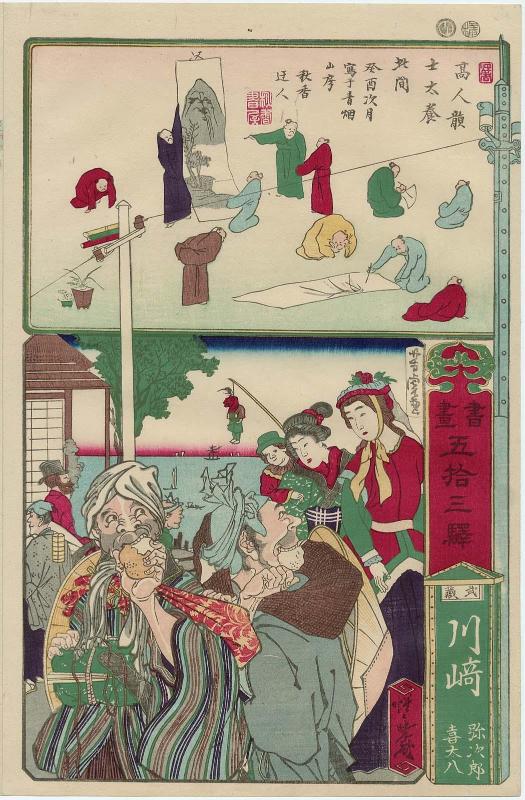
Kawasaki in Musashi Province: Yajirô and Kitahachi, from the series Calligraphy and Pictures for the Fifty-three Stations of the Tôkaidô (Shoga gojûsan eki)
Kawanabe Kyôsai
(Japanese, 1831–1889)
Utagawa Yoshitora
(Japanese, active about 1836–1887)
Sawamuraya Seikichi
(Japanese)
1872 (Meiji 5), 10th month
Medium/TechniqueWoodblock print (nishiki-e); ink and color on paper
DimensionsVertical ôban; 35.5 x 23.5 cm (14 x 9 1/4 in.)
Credit LineWilliam Sturgis Bigelow Collection
Accession number11.41430
On View
Not on viewClassificationsPrints
Collections
After his release from a jail term because he had had done a painting that criticized the new Meiji government, Kyōsai was able to revive his career as an artist with the help of fellow artists of the Utagawa school. This joint Tōkaidō series, combining the work of two to three artists in each design, uses a framing device of the newly introduced telegraph poles. Kyōsai shows the lovable scoundrels Yaji and Kita, the heroes of a well-known comic novel, leering at a pretty foreign woman drawn by Yoshitora. The smaller scene above shows CHinese scholars enjoying a painting and calligraphy party, similar to events sometimes attended by Kyōsai himself.
ProvenanceBy 1911, purchased by William Sturgis Bigelow (b. 1850–d. 1926), Boston [see note 1]; 1911, gift of Bigelow to the MFA. (Accession Date: January 19, 2005)
NOTES:
[1] Much of Bigelow's collection of Asian art was formed during his residence in Japan between 1882 and 1889, although he also made acquisitions in Europe and the United States. Bigelow deposited many of these objects at the MFA in 1890 before donating them to the Museum's collection at later dates.
NOTES:
[1] Much of Bigelow's collection of Asian art was formed during his residence in Japan between 1882 and 1889, although he also made acquisitions in Europe and the United States. Bigelow deposited many of these objects at the MFA in 1890 before donating them to the Museum's collection at later dates.