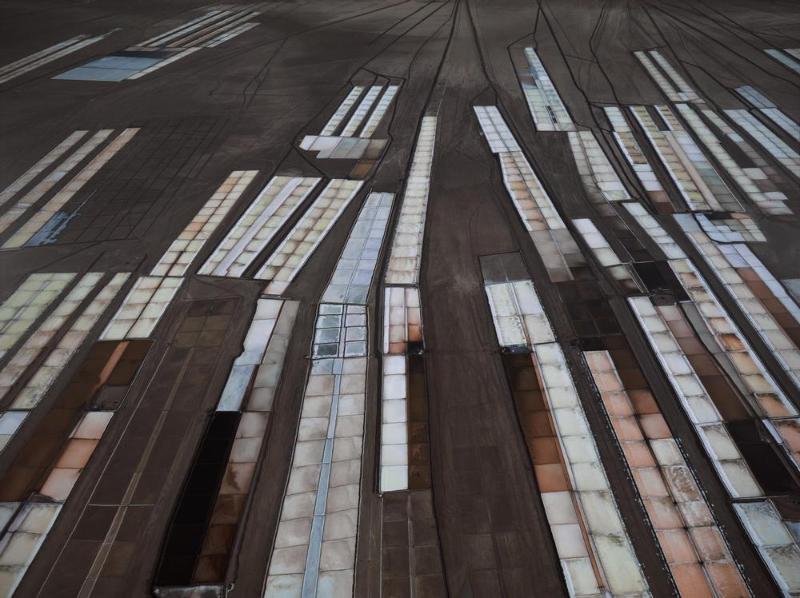
Salt Pan #18, Little Rann of Kutch, Gujarat, India
Framed: 129.5 × 170.2 × 6.7 cm (51 × 67 × 2 5/8 in.)
Edward Burtynsky is an internationally renowned Canadian artist who makes poignant large-scale color photographs of human industrial impact on the landscape. Over the course of his forty-year career, Burtynsky has explored large-scale mining, shipbreaking, manufacturing, oil dependence, and use of water around the globe. His views are very often taken from helicopters or small aircraft. They are at once visually beautiful, and also philosophically terrifying. He used a very high-resolution camera to convey an exquisite level of detail in his large-scale prints. Burtynsky is a recipient of a TED Prize (2004) and also an ICP Infinity Award (2008). His work has been collected by many major museums, including MoMA, SFMOMA, the Whitney, the Guggenheim, LACMA, the National Gallery in DC, the Tate in London, and the Reina Sophia in Madrid.
The Little Rann of Kutch is located in western India, not far from the Gulf of Kutch and the Arabian Sea. The area is one of the largest salt deserts in the world and salt panning is a seasonal activity that provides most of India’s inland salt. Salt pans occur in areas where large bodies of water have evaporated. The abundance of the mineral in the land makes it appear white or whitish. In the Little Rann of Kutch, migrant workers pan for the salt for 6-7 months. It is tedious work under harsh conditions. Their systematic panning causes whitish linear striations in the geographically unique landscape, as seen in Burtynsky's photograph. The area is also a nature preserve and the home to many migratory birds and animals.