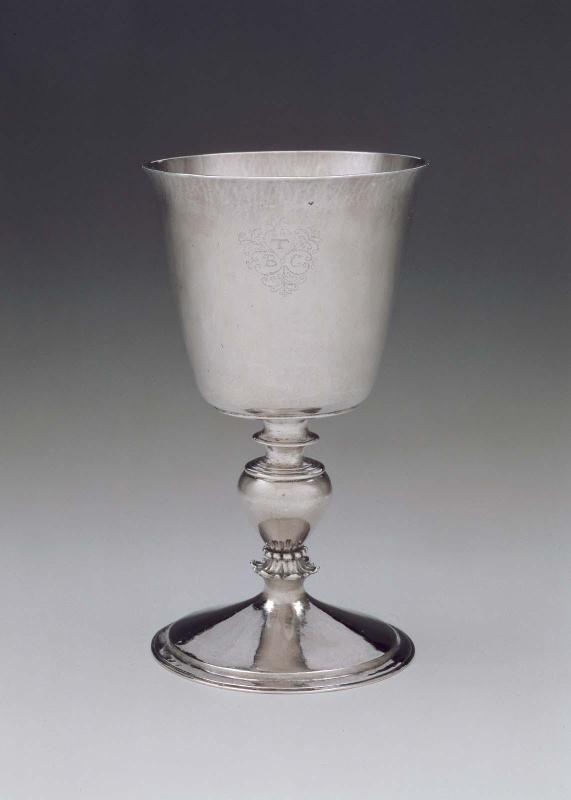
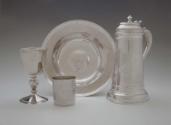
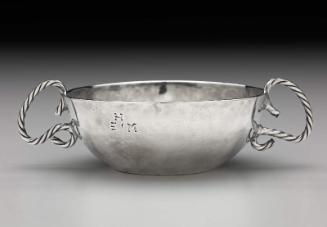
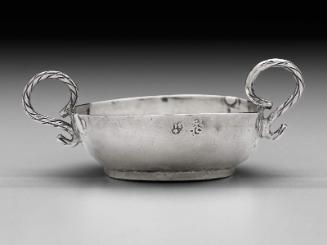
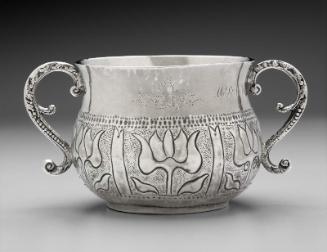
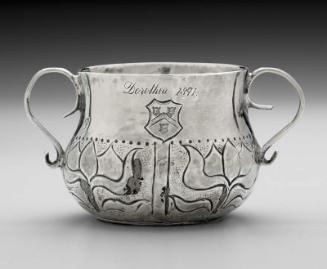
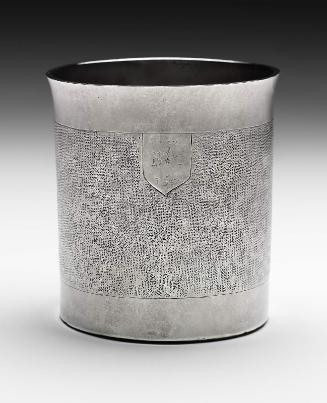
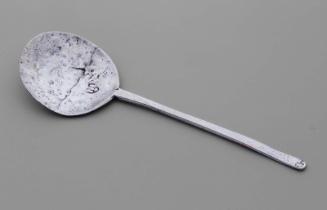
This wine cup and beaker (1990.90), each marked by the partners John Hull and Robert Sanderson, were two of the first silver objects acquired by the First Church of Boston (founded in 1630) and were owned continuously by the church until their acquisition by the MFA in 1999. Together, the vessels represent the beginnings of silversmithing in British North America.The beaker and wine cup were the most common silver forms used by early New England churches in the sacrament of communion. Congregations generally acquired their silver through gifts or bequests. For example, John Winthrop, a founding member and prominent Puritan leader, presented to the First Church a large London-made cup of 1610/11 that he presumably brought with him from England. By the 1650s, however, parishioners could order silver made by Boston craftsmen. One of the church's first local acquisitions was a beaker made by John Hull before 1652 (when he formed his partnership with Sanderson). It is the only known object bearing Hull's mark alone and is similar in style to the Museum's example. By 1680 the church had acquired seven objects made by Hull and Sanderson jointly.The Museum's beaker is engraved simply "T / BC" for "The Boston Church" and "1659"; presumably it was acquired, either as a purchase or as a gift from an unknown donor, in that year. The wine cup, similarly engraved with the church's initials, in addition bears the inscription "The Gift of a Freinde T*C." It has been suggested that the initials are those of Thomas Clarke, a wealthy merchant and active member of the church. Clarke may have owned this cup originally, or it might have been purchased with funds generated by his bequest of £50 to the church.This text was adapted from Ward, et al., MFA Highlights: American Decorative Arts & Sculpture (Boston, 2006) available at www.mfashop.com/mfa-publications.html.
This vessel is the most impressive of the wine cups by Hull and Sanderson that embody Mannerist elements then on the wane in England. The bowl has a wide rim that extends beyond the perimeter of the foot, and its stem, with inverted egg-shaped knop, adds to the unstable feeling. The cast beaded collar and petals below the knop have technical and aesthetic merit that is absent in the other cups.
The cast decoration emulates an English vessel marked “T. G.,” also in the First Church communion service, that was given by Jeremy Houchin between 1635, the time of his arrival in the colony, and his death in 1670. This is the second time that Houchin’s cup may have served as a model for Hull and Sanderson, who probably knew of its matte punched surface when fashioning their tunns (cat. no. 70). The delicately pricked initials of the owner, The Boston Church, within a cloud of foliate ornamentation are a more elaborate version of those found on a cup that the partners made for Richard and Alice Brackett of the Braintree Church.
This text has been adapted from "Silver of the Americas, 1600-2000," edited by Jeannine Falino and Gerald W.R. Ward, published in 2008 by the MFA. Complete references can be found in that publication.