Pines of the Villa Barberini
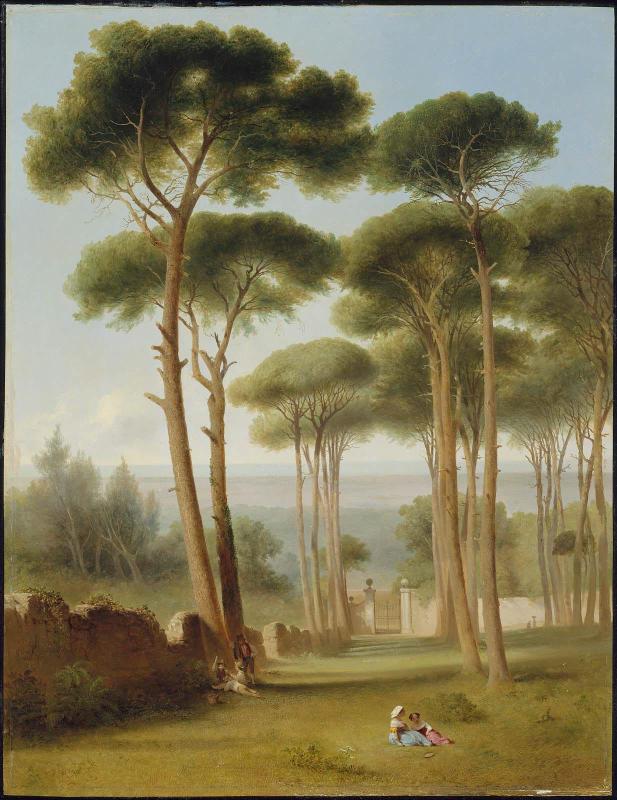
In 1884, British travel writer Augustus J. C. Hare described the attractions of the Villa Barberini: “The beautiful grounds of this villa may always be visited by strangers, and present an immense variety of lovely views, from a foreground, half cultivated and half wild, ending in a grand old avenue of umbrella-pines.”[1]In his Pines of the Villa Barberini, painted almost thirty years earlier, Chapman also focused on these umbrella-shaped stone pines. The trees, which are native to the Mediterranean region and have been cultivated since antiquity for their edible pine nuts, had been planted in pairs on the estate many years before. Taddeo Barberini, nephew of Pope Urban VIII, had acquired the land and built the villa in the seventeenth century. Overlooking Lake Albano in the Alban Hills about fifteen miles southeast of Rome, the area was a popular summer destination for artists, tourists, and Roman nobility, seeking to escape the heat of the city. It now forms part of the papal summer estate at Castel Gandolfo.
Chapman painted Pines of the Villa Barberini six years into an extended stay in Rome. There he had become the unofficial dean of the American expatriate community, and he welcomed American and British travelers to his studio, where they might buy paintings or prints as souvenirs of their visits. Unlike many of Chapman’s paintings there is no commissioner’s name on the reverse of this canvas, as there is on his Harvesting on the Roman Campagna [1972.982]; thus it seems likely that Chapman painted Pines of the Villa Barberini on speculation. It may be the painting to which critic Henry T. Tuckerman referred when he wrote: “A recent letter from Rome . . . alludes to the pictures in Chapman’s studio . . . a group of ‘Stone Pines in the Barberini Valley,’ fine in perspective, and in what I must venture to term silent color, the light which sleeps, as it were on every object in a still summer noon.”[2]
Chapman’s picture includes peasants playing cards and relaxing, but his main attention was lavished on the soaring and graceful pines. He chose a vertical canvas to emphasize the height of the trees and a slightly elevated viewpoint to capture the vista looking northwest across the Campagna toward Rome. The washes of pale color in the background evoke the haze of a sultry afternoon in the Roman countryside. Chapman was not the only American to paint this scene. George Inness, for example, was also attracted to the Villa Barberini and painted three canvases featuring its stone pine trees: The Monk (1873, Addison Gallery of American Art, Andover, Massachusetts), Stone Pines (1874, Virginia Museum of Fine Arts, Richmond), and Pine Grove of the Barberini Villa (1876, Metropolitan Museum of Art, New York). Whereas Inness’s views are painterly and mysterious, influenced by the Barbizon School, Chapman’s earlier portrayal is more naturalistic, luminous, and picturesque.
The early history of ownership of Pines of the Villa Barberini is unknown. Maxim Karolik purchased the painting from a New York dealer in 1945 and gave it to the MFA in 1947, as part of a collection of works painted by American artists between 1815 and 1865 that he had amassed with the advice of the Museum’s curators.
Notes
1. Augustus J. C. Hare, Days Near Rome, vol. 1 (London: George Allen, 1884), 65–66.
2. Henry T. Tuckerman, Book of the Artists (New York: G. P. Putnam & Son, 1867), 221.
Janet L. Comey