Good Hope Road
In 1920, sixteen-year-old Vosdanig Manoog Adoian arrived in the United States. He studied briefly at the Rhode Island School of Design in Providence, Rhode Island, and at the New School of Design (now called the New England School of Art and Design) in Boston, before moving to New York City in 1924. As he embarked on his artistic career, he changed his name to Arshile Gorky, claiming kinship with the Russian novelist Maxim Gorky. Gorky means “bitter one” in Russian, and his choice was also a poignant reference to his horrific childhood in Armenia during the Turkish invasion. Gorky’s memories of Armenia (especially of his mother, who had died of starvation there) coupled with his lyrical response to nature would be the main ingredients of his art.
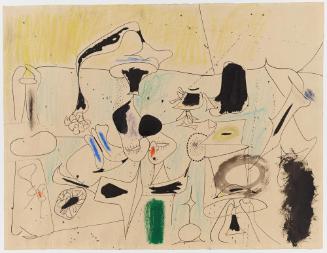
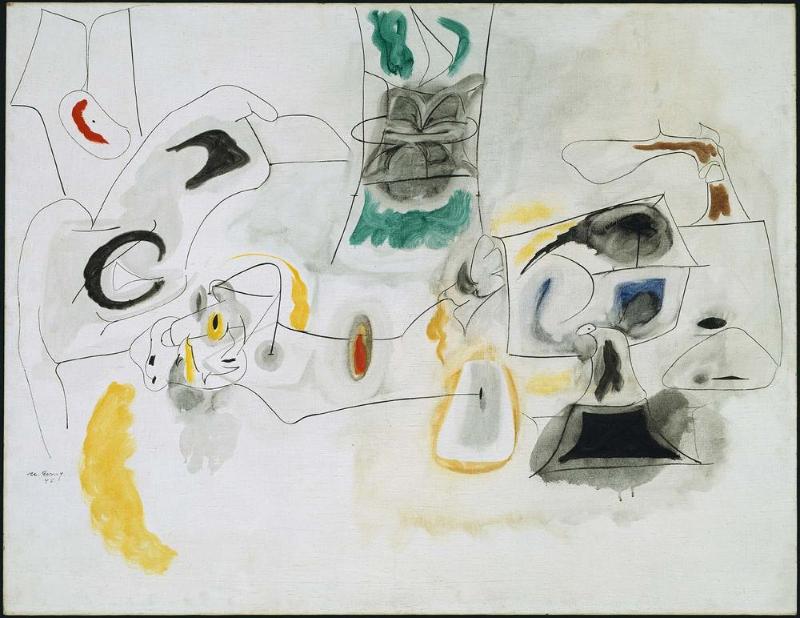
Good Hope Road was painted during a rare period of emotional security and domestic comfort. For about nine months in 1945, Gorky lived on Good Hill Road in Roxbury, Connecticut. There, he and his wife and children enjoyed a happy family life—the life that had been wrenched from him in Armenia—in bucolic surroundings. His career was also flourishing: that same year he was taken on by the Julien Levy Gallery, the premier gallery for avant-garde art in New York. His paintings sold well, and the influential critic Clement Greenberg, writing for The Nation in 1946, described the solo show in which this painting appeared as featuring “some of the best modern painting ever turned out by an American.” [1]
Another of Gorky’s compositions from 1945, entitled Good Hope Road II. Pastoral (also known as Hugging; Museo Thyssen-Bornemisza, Madrid), shows two figures embracing in an interior lit by firelight. The MFA painting more likely shows a landscape, perhaps with a figure reclining before a tree. Together, these works summarize Gorky’s feelings of contentment. In them, he emphasized drawing to a greater degree than he had earlier; long beautiful lines, biomorphic shapes, and patches of diluted color float across the picture, only occasionally intersecting one another. They create an atmospheric, dreamy world that appeals as much to the heart as to the mind. Gorky’s paintings of the 1940s added a profound spiritual component to the language of abstraction, and paved the way for the work of artists such as Jackson Pollock [1984.749, 1971.638] and Franz Kline [1973.636].
Notes
1. Clement Greenberg, May 4, 1946, review of Gorky exhibition, reprinted in John O’Brian, ed., Clement Greenberg: The Collected Essays and Criticism, vol. 2, Arrogant Purpose, 1945–1949 (Chicago: University of Chicago Press, 1986), 79.
This text was adapted from Elliot Bostwick Davis et al., American Painting [http://www.mfashop.com/9020398034.html], MFA Highlights (Boston: MFA Publications, 2003).