
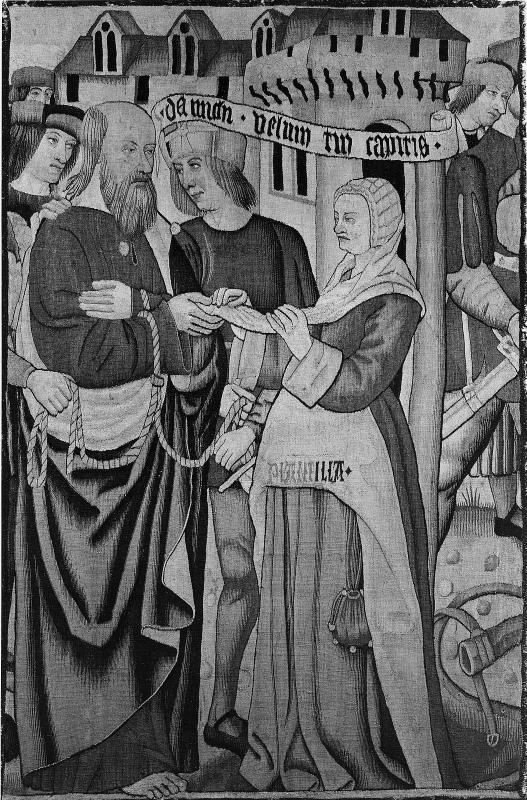
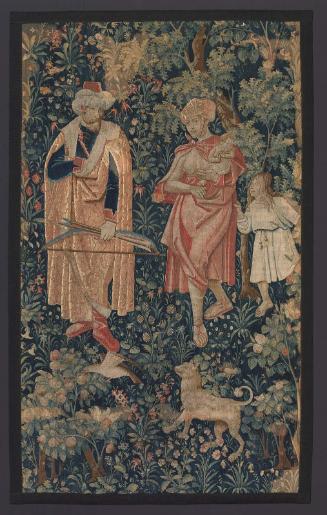
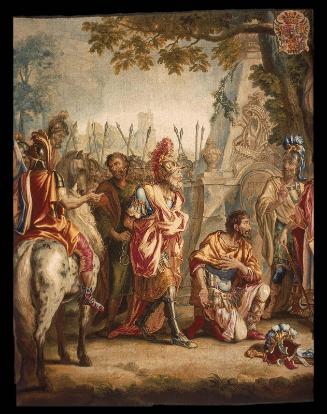
Tapestry: Saint Paul Requesting Plautilla's Veil (possibly from a series of hangings illustrating the Life of Saint Paul)
Late 15th or early 16th century
Object PlaceFrance or the Franco-Flemish Territories
Medium/TechniqueTapestry weave (wool warp; wool wefts)
Dimensions121 x 173 cm (47 5/8 x 68 1/8 in.)
Credit LineGift of William de Krafft
Accession number49.79
On View
Not on viewClassificationsTextiles
Collections
Provenance1928, Arnold Seligmann, Rey et Cie., Paris [see note 1]. By 1929, Georges Haardt and Co., Inc., Paris and New York (stock no. 1206) [see note 2]; 1937, probably sold by Haardt to William de Krafft (b. 1878 - d. 1963), Heronden Hall, Tenterden, Kent, England and New York [see note 3]; January 28-29, 1949, anonymous (Krafft) sale, Sotheby Parke-Bernet, New York, lot 410, bought in by William de Krafft and given to the MFA. (Accession Date: February 10, 1949)
NOTES:
[1] The gallery lent it to the "Exhibition Gothique de la Manufacture Nationale des Gobelins" (June, 1928), cat. no. 39. [2] Georges Haardt consigned the tapestry to Jacques Seligmann and Co. beginning in 1929. Archives of American Art, Jacques Seligmann and Co. Papers, Series 7.18, Miscellaneous Financial Notes and Files, Box 357, folder 3: Statements and Notes, Georges Haardt, 1927-1934. [3] Dealer Germain Seligman wrote to Georges Haardt (May 7, 1937) about the tapestry, then in Haardt's possession, saying that he had known it "for a great many years." Archives of American Art, Jacques Seligmann and Co. Papers, Series I, General Correspondence, Box 44, folder 4: Haardt, Georges. Krafft acquired the tapestry on the New York art market in 1937.
NOTES:
[1] The gallery lent it to the "Exhibition Gothique de la Manufacture Nationale des Gobelins" (June, 1928), cat. no. 39. [2] Georges Haardt consigned the tapestry to Jacques Seligmann and Co. beginning in 1929. Archives of American Art, Jacques Seligmann and Co. Papers, Series 7.18, Miscellaneous Financial Notes and Files, Box 357, folder 3: Statements and Notes, Georges Haardt, 1927-1934. [3] Dealer Germain Seligman wrote to Georges Haardt (May 7, 1937) about the tapestry, then in Haardt's possession, saying that he had known it "for a great many years." Archives of American Art, Jacques Seligmann and Co. Papers, Series I, General Correspondence, Box 44, folder 4: Haardt, Georges. Krafft acquired the tapestry on the New York art market in 1937.

3rd-4th century AD

1920–40
Francesco Albani
First half of the 18th century A.D. 1700–50
First quarter of the 16th century
Albrecht Dürer
First quarter of the 16th century

Second half of the 16th century
Second half of the 16th century or first quarter of the 17th century
1675–1725
Maximilien de Haese
about 1771–75